
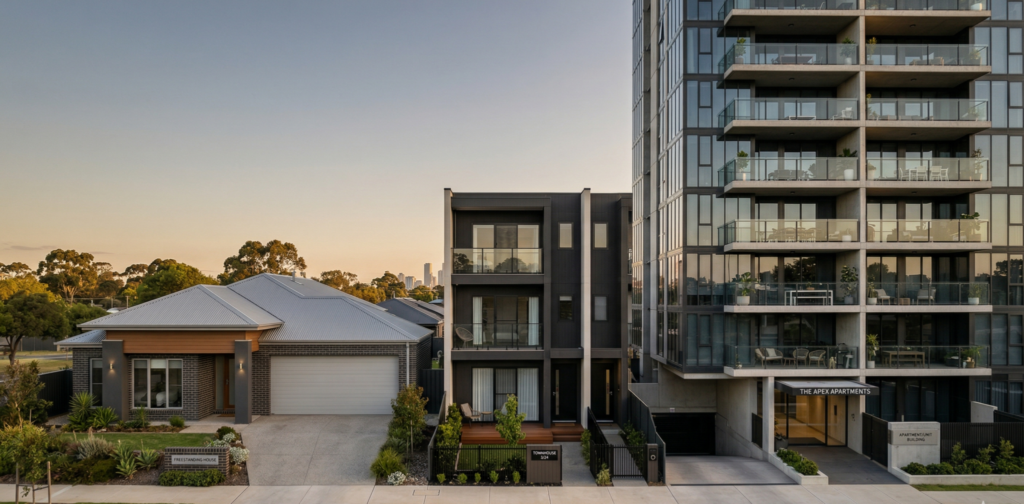
If you’re trying to work out the best property type for investment Australia in 2026, you’re asking the right question at the right time. Higher interest rates and tighter borrowing rules mean investors can’t just “buy anything and wait”. The best choice depends on your budget, the suburb, your cash flow needs, your tolerance for maintenance and strata costs, and the quality of the specific property you’re considering.
This guide compares houses, townhouses and units using current Australian market data, plus practical investor realities like holding costs, land component, oversupply risk, and owner-occupier appeal. The goal is not to tell you “houses always win” or “units are always better” — it’s to give you a framework to choose the right property type for your strategy in best investment property type Australia 2026 conditions.
Key takeaways
- In 2026, affordability and serviceability matter more. Borrowers face a 3% serviceability buffer, and lenders may assess new loans at roughly 9% in practice, so your budget is often smaller than your deposit suggests.
- Houses usually carry more land value and scarcity, which is strong for long-term capital growth, but entry prices and maintenance can be higher.
- Townhouses often sit in the middle: more affordable than houses in similar areas, more house-like appeal than many apartments, and sometimes a meaningful land component — but title type and strata rules can change the numbers.
- Units can offer better rental yield and entry affordability, but performance varies widely by building quality and supply pipeline. Body corporate costs and special levies are a real risk to cash flow.
- 2026 is not one national market. Major differences remain by city and segment, with stronger growth in some mid-sized capitals and softer patches in others.
- A great unit in a tightly held location can beat a bad house in a weak location. Property type matters, but asset quality and location can matter more.
Why this question matters more in 2026
Three forces make the house vs townhouse vs unit investment decision more important in 2026 than it felt in the ultra-low-rate era.
Borrowing capacity is constrained. The cash rate was lifted to 4.10% in March 2026, and overall financial conditions have tightened as a result. Prudential settings still require lenders to apply a 3 percentage point serviceability buffer when assessing borrowers. In practical terms, many investors need to show they can service debt at around a 9% assessment rate.
Holding costs are structurally higher than the 2020–2021 cheap debt period. Even before council rates, insurance, repairs, and property management, interest costs alone can dominate the cash flow outcome. With average new investor housing loan rates sitting well above the low-rate era, investors must be deliberate about whether they are targeting capital growth, cash flow, or a blend.
Rental demand is still tight, but the cash flow maths is not automatic. Vacancy rates remain low across much of Australia. Tight vacancies can support rents, but investors still need buffers for costs, especially strata, insurance, and maintenance shocks.
Affordability pressure is shaping demand and pushing investors to compromise. Many buyers can no longer afford freestanding houses in strong suburbs, which pushes more demand towards attached housing, outer-ring markets, and smaller dwellings.
Investor participation is rising again. Investor lending activity remains strong, which adds competition in the same price brackets many investors are targeting.
House vs townhouse vs unit investment in 2026
At a high level, you can think of the three main dwelling types like this:
Houses tend to win on land value, scarcity and owner-occupier demand, which are often the ingredients behind strong long-term capital growth. But they usually require the biggest budget, and the owner carries all maintenance responsibility.
Townhouses often sit between houses and units. They can offer a more affordable entry than a freestanding house in the same catchment, while still appealing to family tenants and owner-occupiers. But townhouse is not a title type. In Australia, townhouses are commonly strata titled, or sometimes Torrens or freehold, depending on the development and state.
Units are typically the most affordable entry point and can offer better rental yields, but they come with more variance: building quality, strata costs, oversupply risk in some pockets, and weaker land component per dwelling can all affect long-term outcomes.
2026 data snapshot: Nationally, houses continue to show stronger long-term growth characteristics, while units generally offer better gross rental yields and lower entry prices. That is the core trade-off in one line: houses = more growth and land, units = more yield and affordability.
| Property type | Typical strengths | Typical weaknesses | Yield profile | Maintenance profile | Land component | Strata/body corporate exposure | Typical growth profile | Best suited to which investor |
|---|---|---|---|---|---|---|---|---|
| House | Scarcity of land; strong owner-occupier appeal; renovation and upside flexibility | Highest entry cost; lower yields; more direct maintenance responsibility; can be too expensive for serviceability in 2026 | Typically lower | Higher and more variable because you own everything | Usually strongest | Usually none unless part of a community scheme | Often strong over long horizons; can be more resilient in land-constrained areas | Growth-focused investors with comfortable serviceability and maintenance tolerance |
| Townhouse | Balanced affordability and liveability; family tenant appeal; often lower oversupply risk than high-rise; some land component | Varies by title; strata or owners corporation costs can change cash flow; some developments are highly replicable | Often mid-range | Moderate | Moderate and highly variable | Sometimes | Often a middle ground; can outperform in affordability-driven family markets | Balanced investors who want a compromise between land content, yield and entry price |
| Unit | Lower entry price; often higher yields; strong rental demand near jobs, education and transport | Higher variance; strata fees and special levies can hit returns; oversupply risk in some precincts; less land per dwelling | Typically higher | Lower day-to-day inside the lot, but shared building issues can create large one-off costs | Usually lowest | High | Highly location and building dependent; can be excellent in scarce, tightly held stock | Yield-focused or lower-budget investors who can assess strata and supply risk well |
Houses as an investment in 2026
Houses are often considered the default for long-term capital growth, and there are good reasons investors still chase them in 2026. But the key is buying a quality house in a demand-led location that still fits your serviceability and holding-cost buffers.
How houses typically perform on rental yield
House yields are usually lower than units because house prices are higher relative to rents. In expensive markets like Sydney, the gap can be particularly large.
Investor implication: At today’s interest costs, many houses will be cash flow negative unless you have a very large deposit, unusually strong rents, or you buy in a market where house yields are higher. That’s not bad — it just means the strategy is usually more growth-focused than cash flow-focused.
How houses typically perform on long-term capital growth
Houses usually deliver stronger long-term growth when the value is driven by land scarcity and strong owner-occupier demand, such as school catchments, transport access, lifestyle amenities, and limited developable land.
That said, the lead is not universal in every city or every year. In several markets, units have outperformed houses recently due to affordability constraints and shifting demand. This is why simplistic rules like “houses always win” can mislead investors.
Maintenance costs and resilience
With a house, you own and pay for everything: roof, exterior, fences, gardens, stormwater, and structural repairs. That means maintenance is more controllable because you decide what to do and when, but it is also more exposed to surprises, especially for older stock.
Scarcity, replication risk, and owner-occupier appeal
Freestanding houses in established suburbs are generally harder to replicate quickly than apartments because detached housing supply is constrained by land availability and planning limits.
Investor implication: Where you can still afford a good house in a strong area, you are often buying an asset class with deep owner-occupier demand, which can support growth and resale liquidity.
When a house can be the wrong choice in 2026
Houses can be a poor investment when the price forces you into thin cash buffers, or when you buy a cheap house in a location with weak demand drivers. In 2026, serviceability constraints are pushing demand to more affordable segments, and higher price points can face bigger headwinds.
Watch-outs: structurally compromised buildings, flood or fire exposure, weak local owner-occupier demand, and areas where new land supply can expand quickly.
Townhouse investment Australia in 2026
Townhouses can be an excellent middle-ground option in 2026, especially for investors priced out of freestanding houses in good suburbs but still wanting family appeal, some land component, and tighter supply than high-rise towers.
First: understand what data calls a townhouse
Many Australian datasets do not separate townhouses cleanly. In practice, townhouses are often blended into the broader unit category in market reporting. That matters because townhouse performance is often hidden inside average unit data.
Investor implication: You often need suburb-level comparables and on-the-ground supply analysis rather than relying purely on city-level unit averages for townhouses.
How townhouses typically perform on rental yield
Townhouses often rent well to families and couples who want space plus low-maintenance living. Yields are frequently better than comparable houses in the same area because the purchase price is lower, but can be dragged down by strata levies if the property is in a complex with higher shared costs.
How townhouses typically perform on capital growth
Townhouses tend to grow well when they sit in locations where families are constrained by affordability but still want a home-like lifestyle. In these markets, townhouses can benefit from both tenant demand and owner-occupier demand.
However, new townhouse supply can ramp up quickly in growth corridors where land is available and planning supports medium density. That can reduce scarcity and limit growth if stock becomes too easy to replicate.
Strata/body corporate and title risk
Some townhouses are effectively house-like with minimal shared facilities, while others operate like multi-unit complexes. If there is a body corporate, your returns depend on levy levels and how well the scheme plans for long-term maintenance.
Investor implication: A townhouse can be a brilliant asset or a cash flow trap depending on levies, insurance costs, and whether major works are looming.
Best use cases for townhouses in 2026
- Investors who want a compromise between land content and affordability.
- Investors who prefer family-oriented tenant demand.
- Investors who want less maintenance than a standalone house but do not want high-rise risks.
- Investors who need an entry point that still works under 2026 serviceability conditions.
Units as an investment in 2026
Units and apartments are often the most realistic entry point for investors in 2026, especially in higher-priced capitals where house prices stretch serviceability. But units are the property type where asset selection matters most. Two units 500 metres apart can produce very different outcomes depending on supply, strata costs, and owner-occupier appeal.
How units typically perform on rental yield
Units often look attractive on yield because they are cheaper to buy relative to the rent they can earn. Some cities show especially wide yield gaps between houses and units.
But yield is not the same as cash flow. Gross yield does not include strata levies, special levies, insurance, management, repairs inside the lot, vacancies, or interest costs.
How units typically perform on long-term capital growth
Unit capital growth is highly location and supply dependent. In some markets, units have recently outpaced houses, especially when affordability pushes buyers towards more attainable stock.
At the same time, other markets and periods show houses clearly ahead. Nationally, houses still tend to lead over longer periods. This is a reminder that units are not always bad, but you must buy the right ones.
Oversupply risk and replication risk
Oversupply risk is usually local rather than national. It is highest where many near-identical apartments can be delivered into the same rental pool, often near CBDs, major redevelopment precincts, or large transport corridors.
This is why some unit markets can face bigger supply waves than detached housing markets.
Strata and building-quality risk
A unit’s financial performance is tied to the building. Strata structures are designed to fund maintenance and insurance via levies and long-term plans, but investors must check whether the budgets are realistic and whether major works are pending.
Investor implication: In unit investing, due diligence on strata records, sinking or capital works plans, and insurance claims history is not optional. It is core risk management.
Best use cases for units in 2026
- Investors who need a lower entry price and higher yield potential.
- Investors who want strong rental demand near jobs, universities, hospitals, and transport.
- Investors who are comfortable doing deeper due diligence on strata and supply pipeline.
- Investors who want a more hands-off lifestyle asset.
How to choose the best property type for investment Australia in 2026
The best property type is the one that fits your constraints and goals while still being a high-quality asset in a good location. Use this decision framework.
Step one: set the strategy
If your goal is capital growth: houses often lead because of land scarcity and owner-occupier depth, but only if you can buy in an area with enduring demand and limited easy new supply. If houses in those locations are out of reach, a well-located townhouse or a scarce, owner-occupier-grade unit can still deliver strong outcomes.
If your goal is cash flow: units and sometimes townhouses can lead because yields are generally higher. However, you must model net yield after strata, insurance and maintenance, not just gross yield.
If your goal is a middle-ground: townhouses can be a sweet spot, especially in affordability-stretched family markets where tenants and owner-occupiers want space but cannot stretch to a freestanding house.
Step two: pressure-test your borrowing capacity and buffers
In 2026, many investors are limited by serviceability, not deposit. Higher assessment rates, tighter lending settings, and debt-to-income controls mean your holding costs and vacancy buffers matter more than ever.
Step three: match property type to tenant demand in your target location
- Houses tend to suit families, often with longer tenancies.
- Townhouses often attract families and couples wanting space without a large yard.
- Units often attract singles, couples, students and key workers near employment and transport.
Vacancy conditions remain tight in many locations, but they do not remove property-type risks like strata shocks or oversupply in specific pockets.
Which property type may suit different investor profiles
Investors focused on capital growth: Often a quality house is the strongest default if you can afford it in a land-constrained, owner-occupier-led suburb. If not, consider a townhouse in a strong family catchment or a scarce, boutique unit rather than a generic investor-grade tower.
Investors focused on cash flow: Units frequently deliver higher gross yields. Townhouses can also work when rents are strong and strata costs are modest. Always run net numbers with levies and insurance included.
Lower-budget investors: Units and townhouses are often the most viable way to enter the market without over-stretching serviceability.
Lower-maintenance investors: Units and some townhouses can reduce personal maintenance workload, but do not confuse less DIY with no risk. The risks simply shift into levy budgets, capital works planning and insurance.
Investors wanting stronger land content: Houses generally win. If houses are out of reach, look for townhouses with meaningful land allocation and strong owner-occupier appeal, or older low-rise units in premium locations where land scarcity is high and the building is well maintained.
Key risks with each property type
House risks
Cash flow and serviceability risk: lower yields plus higher interest costs can create persistent negative cash flow if buffers are thin.
Maintenance and capex shocks: large one-off repairs such as roofing, drainage or structural issues can be expensive and unpredictable.
Location trap: a cheap house in a weak market can underperform a good unit in a strong market.
Townhouse risks
Title and levy complexity: townhouse costs and control depend on whether it is strata, community title, or Torrens or freehold.
Replicability: some townhouse products are easy for developers to replicate in growth corridors, increasing competition and limiting scarcity.
Fee shocks: unexpected major works can lead to higher levies or special fees.
Unit risks
Strata shocks: special levies for extraordinary expenditure can materially change net yield and can be hard to finance quickly.
Oversupply pockets: large approval waves and building pipelines can create competitive rent and resale conditions in specific precincts.
Building quality and insurance: the whole investment depends on the building’s health, governance and insurance costs.
The role of location in whether a house, townhouse, or unit is better
Location determines your demand base, your supply risk, and your future buyer pool, all of which can outweigh property type alone.
In premium, tightly held suburbs: houses can be extremely expensive, and well-located boutique units or townhouses can become compromise stock with strong demand.
In inner-city apartment precincts: rental demand can be deep, but supply can also be deep. In these markets, building selection and scarcity are more important than simply choosing a unit.
In middle-ring family markets: townhouses can outperform when buyers want space and schools but cannot reach a house price.
In outer growth corridors: houses and townhouses may be more affordable, but check whether new land releases and continuous construction reduce scarcity.
Common investor mistakes when choosing property type
Chasing the highest advertised yield without modelling net yield. Gross yields ignore strata levies, insurance, maintenance and vacancies. In 2026’s rate environment, that mistake is expensive.
Assuming units are bad or houses always win. Outcomes differ by city and cycle, and even units can outperform in some affordability-driven periods.
Buying a townhouse without confirming title and governance. Townhouse describes a building style, not the legal structure.
Ignoring supply pipeline risk for units. Oversupply is local, but approval waves can translate into future competition.
Over-stretching on a house in a high-priced suburb with thin buffers. Higher rates and cost-of-living pressure mean investors need stronger cash buffers than in the ultra-low-rate era.
FAQ
Is a house or unit better for investment in Australia?
Neither is always better. Houses often have stronger land content and owner-occupier demand, while units are usually more affordable and often deliver higher gross yields. The better option depends on your budget, cash flow needs, and the suburb’s demand and supply balance.
Are townhouses a good investment in 2026?
Townhouses can be a great investment in 2026 when they are in family-driven suburbs where houses are unaffordable, and when strata or owners corporation costs are reasonable and well managed. The key is to confirm title type and assess levy structures and long-term maintenance planning.
What property type has the best capital growth?
Over long horizons, houses often lead due to land value and scarcity, but it is not universal. The best property for capital growth Australia is usually the best asset in the best location, not automatically a specific property type.
What property type has the best rental yield?
Units typically have higher gross yields than houses because they are cheaper to buy relative to rent. But investors should model net yield after strata, insurance and maintenance.
Are strata costs worth it for investors?
They can be, if the building is well managed and the levies fund real maintenance and adequate insurance. The risk is unexpected special levies for major expenditure, which can hit cash flow and resale confidence.
Is land component really that important?
Land component matters because land is finite in established areas and tends to be a key driver of scarcity and long-term price growth. That said, land component is not the only driver. Location, demand depth, and asset quality still decide outcomes.
Should a beginner investor buy a unit, townhouse, or house?
In 2026, beginners often do best choosing a property type that protects cash buffers and minimises surprise-cost risk. Units and townhouses can be more affordable and higher yielding, but include strata risk. Houses can be simpler legally, but require bigger budgets and more maintenance responsibility.
Last updated: 8 April 2026 (Australia/Sydney)