
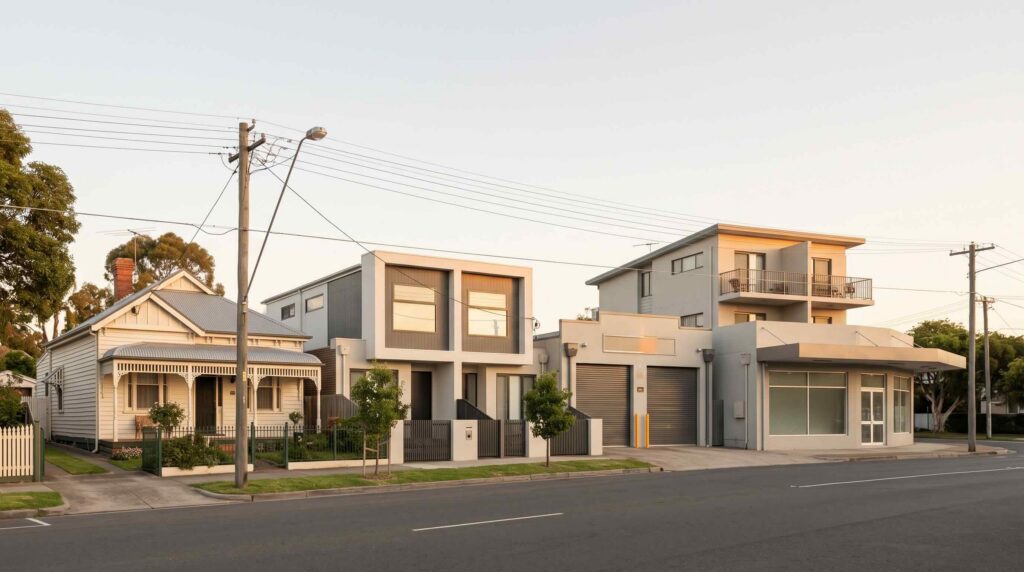
Most people searching for an investment property start with a suburb. The better place to start is the type of property, because the type decides almost everything that follows: the yield you can expect, what a lender will fund, how much of your time it consumes, how it’s taxed, and who will buy it from you when you sell. From 1 July 2027, the type you buy also decides whether you can negatively gear it.
This guide covers every one of the types of investment property in Australia — 24 options across four categories — with the pros, cons, lending realities and due diligence for each, plus a framework for choosing between them.
Key takeaways
- There are four categories of investment property in Australia: residential buy-and-hold, specialist and higher-yield residential, commercial, and development or value-add — 24 distinct property types between them.
- Start with the job, not the suburb. Capital growth comes from land in supply-constrained locations; cash flow comes from more rent per dollar — multiple incomes on one title, rooms instead of houses, or commercial tenants who pay the outgoings.
- Lenders sort property types before you do. Standard residential borrows to 80–90% of value; rooming houses, SDA, student studios and commercial borrow far less, and some niche assets barely at all.
- Higher yield is always compensation for something — regulation, management, narrower lending, policy dependence, or a smaller pool of buyers when you sell.
- From 1 July 2027, property type decides your tax treatment. Negative gearing on residential property is limited to new builds, established homes bought after 12 May 2026 have their losses quarantined, and commercial property is unaffected.
- There is no single best type. The right one matches your goal, borrowing capacity, time, risk tolerance and structure — and niche assets need niche due diligence.
In this guide
- How to choose the right type of investment property
- How the 2026 tax changes affect each property type
- Every investment property type at a glance
- 1. Residential buy-and-hold
- 2. Specialist and higher-yield residential
- 3. Commercial property
- 4. Development and value-add strategies
- Residential vs commercial property investment: the key differences
- Common mistakes when choosing a property type
- Frequently asked questions
- Choosing your next property
How to choose the right type of investment property
Start with what the property has to do for you, then let that filter the menu. Six questions do most of the work.
1. Growth, cash flow or both?
Capital growth comes mainly from land in locations where demand outruns supply, which is why established houses in supply-constrained suburbs are the most common growth play. Cash flow comes from extracting more rent per dollar of property: multiple incomes on one title, rooms instead of houses, or commercial tenants who pay the outgoings.
Higher yield almost always costs something — more management, more regulation, narrower lending, a smaller resale market, or less land per dollar. Most portfolios end up blending the two.
2. What will a lender actually fund?
Lending appetite varies more by property type than most investors expect:
- Standard residential (houses, units over roughly 50 sqm, duplexes): widest lender panel, loan-to-value ratios (LVR) up to 80–90%, higher with lenders mortgage insurance.
- Specialist residential (rooming houses, SDA, student studios, DHA, retirement units, serviced apartments): fewer lenders, often lower LVRs, and some lenders value the property as if it were an ordinary house.
- Commercial: typically 55–70% LVR, higher interest rates, shorter loan terms and, in many cases, annual reviews.
- Development: construction or development finance, assessed on the feasibility, presales and your track record.
The rent a property earns is not the rent the bank counts. Talk to a broker before you fall for a yield.
3. How much of your time?
Passive: an established house with a property manager, a DHA leaseback, or a net-lease commercial asset. Active: short-stay, rooming houses, renovations, and anything with “development” in the name. Be honest about which one you are, because the yield on an active asset assumes you show up.
4. Risk and regulation
Three risks to price in: concentration (five rooming houses in one council area is one regulatory decision away from trouble), policy (short-stay caps, SDA funding settings and negative gearing rules have all changed in the last three years), and tenant (a single-tenant commercial property can sit empty for 6–18 months between leases).
5. Exit and liquidity
Who buys it from you? Established houses sell to owner-occupiers and investors, the widest pool there is. Niche assets — a rooming house, an SDA dwelling, a property mid-way through a DHA lease, a 25 sqm student studio — sell only to other investors who understand them. That shows up in price and time on market.
6. Structure and tax
The entity you buy in (individual, trust, company or SMSF) affects land tax thresholds, capital gains tax, negative gearing and your ability to borrow. From 1 July 2027 it also determines whether rental losses reduce your salary income at all, which is why the next section exists.
How the 2026 tax changes affect each property type
The Treasury Laws Amendment (Tax Reform No. 1) Act 2026 passed Parliament on 25 June 2026 and takes effect from 1 July 2027. It changes the after-tax maths of property type in three ways:
- Negative gearing on residential property is limited to new builds. Established residential property purchased after 7:30pm AEST on 12 May 2026 can no longer offset rental losses against salary or other income from 1 July 2027. Losses are quarantined — they can be used against other residential rental income or capital gains from rental property, and carried forward. Properties owned or under contract before the cut-off are grandfathered until sold.
- The 50% CGT discount is replaced. For individuals, trusts and partnerships, gains accruing from 1 July 2027 are taxed on an inflation-indexed cost base with a minimum 30% tax rate. Gains accrued before that date keep the discount under transitional rules. This applies to all CGT assets, commercial property included. Eligible new builds keep access to the 50% discount.
- Commercial property and super are carved out. Commercial property can still be negatively geared. Super funds (including SMSFs) and widely held trusts are excluded from the changes, although the June 2026 amendments also restrict SMSFs from borrowing to buy residential property. A separate 30% minimum tax on discretionary trust distributions is planned from 1 July 2028 under future legislation.
What counts as a new build is the pivot. A dwelling qualifies where it adds to housing supply: a new house on vacant land, a newly constructed apartment bought off the plan, or a knock-down rebuild that replaces one dwelling with two or more. A one-for-one knock-down rebuild, a substantial renovation, or a granny flat added to an established house does not qualify under current guidance. Build-to-rent and government affordable housing programs are exempt.
| Property | Negative gearing from 1 July 2027 | CGT from 1 July 2027 |
|---|---|---|
| Established residential bought after 12 May 2026 | Losses quarantined (rental income or property gains only) | Indexation + 30% minimum tax on gains accrued after 1 July 2027 |
| Established residential owned before 12 May 2026 | Unchanged until sold (grandfathered) | 50% discount on gains accrued before 1 July 2027; new rules after |
| Eligible new build | Retained | 50% discount retained |
| Commercial property | Retained | Indexation + 30% minimum tax |
| Property held in super | Super rules apply | Excluded from the changes |
None of this makes any property type good or bad. It changes the cash flow and exit numbers, and those need to be modelled on your income and structure by your accountant before you buy — not after. Our guide to tax deduction strategies for property investors covers the deductions that still apply.
Every investment property type at a glance
Indicative gross yields are broad September 2026 ranges before costs. They vary with location, quality, lease terms and interest rates, and they are not predictions.
| Property type | Indicative gross yield | Main value driver | Effort | Lending | Resale market |
|---|---|---|---|---|---|
| Established house | 3–4.5% metro, 4.5–6% regional | Land | Low | Standard, up to 80–90% | Widest |
| Dual occupancy / duplex / dual-key | 5–7% | Land + two incomes | Low–medium | Standard (dual-key restricted) | Wide (dual-key narrow) |
| Block of units | 4–6% | Land + income density | Medium | Standard to 4 units; often commercial above | Investors |
| Holiday / short-stay | 6–12% gross, far less net | Location + occupancy | High | Standard, on long-term rent appraisal | Wide (as a home) |
| Regional / lifestyle acreage | 2.5–4.5% | Land + lifestyle demand | Medium | Restricted on rural / large lots | Owner-occupiers + investors |
| Rooming house / co-living | 8–12% | Income | High | Few lenders, lower LVR | Investors only |
| NDIS / SDA | 8–15% advertised, subject to occupancy | Government-funded income | Medium–high | Restricted | Very narrow |
| Student accommodation | 6–9% | Income | Medium | Studios under ~50 sqm often unfundable | Investors only |
| DHA leaseback | 3.5–5% before fee | Guaranteed lease | Very low | Standard | Investors during lease |
| Retirement village unit | 5–8% (exit fees apply) | Income | Low | Mostly cash only | Very slow |
| Retail | 5–7.5% | Lease income | Low–medium | Commercial, 55–70% | Investors |
| Office | 6–8.5% | Lease income | Medium | Commercial | Investors, owner-occupiers |
| Industrial | 4.5–6.5% | Lease income + land | Low | Commercial | Investors, owner-occupiers |
| Essential services | 4.5–6.5% | Long lease | Very low | Commercial | Investors |
| Single-tenant net lease | 4.5–6% | Tenant covenant | Very low | Commercial | Investors |
| Hospitality freehold | 6–9% | Land + operator | Medium | Specialist | Narrow |
| Mixed-use | 5–7% | Two incomes | Low–medium | Often commercial | Moderate |
| Farmland | 2–5% leased | Land + water | Medium–high | Specialist rural | Narrow |
| Development / value-add | Profit on cost, not yield | Manufactured equity | Very high | Construction / development finance | Depends on end product |
1. Residential buy-and-hold
The mainstream of Australian property investment: buy a dwelling, rent it to a household, hold for growth. Lending is easiest here, resale is widest, and the differences between the five options are mostly about how much land you get per dollar and how many rents one title produces.
Established house
The default investment property: a freestanding house on its own block, bought as-is and rented to one household. Its value is mostly land, which is the part that appreciates; the building depreciates and needs maintenance.
- Pros: Widest buyer and tenant pool; the cheapest, simplest finance; scarce land in supply-constrained suburbs is the most reliable long-term growth driver; easy to manage through a property manager; renovation, granny flat and subdivision optionality later.
- Cons: The lowest yields on the residential menu — often negative cash flow in capital cities after interest and costs; maintenance on older stock (roofs, wiring, plumbing); purchases after 12 May 2026 lose negative gearing against salary income from 1 July 2027.
- Best suited to: Investors with strong income and borrowing capacity who prioritise capital growth over cash flow and plan to hold for 10+ years.
- Check before you buy: Building and pest report; flood, bushfire and heritage overlays; zoning and minimum lot size (subdivision potential); vacancy rate and days on market; and how the after-tax cash flow looks under the new negative gearing rules.
Dual occupancy, duplex and dual-key properties
Three variations on one idea: two rentable dwellings, usually on one title.
Dual occupancy is two dwellings on one lot, typically a house with an approved secondary dwelling (granny flat) or a purpose-built pair. A duplex is two attached dwellings on one lot; each half can usually be put on its own title (Torrens or strata) later. A dual-key property is a single dwelling with a lockable, self-contained section (own kitchen and bathroom) behind a shared entry, most common in apartments.
- Pros: Two incomes for one purchase, one lot of stamp duty and usually one land tax assessment; yields of 5–7% are typical; a duplex you can later split into two titles carries built-in equity; a dual occupancy still reads as a house to most lenders.
- Cons: The land is shared between two dwellings, so the land-to-asset ratio is lower; dual-key apartments have a narrow resale market and some lenders restrict them; poor designs create separate-metering, fire-separation and privacy problems; two vacancies to manage instead of one.
- Best suited to: Investors who want cash flow without leaving residential lending, and anyone building a balanced portfolio.
- Check before you buy: Council approval for both dwellings (an unapproved conversion is uninsurable and, in practice, un-rentable); separate power, water and gas meters; whether the second dwelling was approved as a secondary dwelling (restrictions on selling separately) or as a duplex (title separation possible); strata by-laws where relevant.
For a closer look at the numbers and the traps, see our guide to dual occupancy investment in 2026.
Block of units (buying “in one line”)
A whole small apartment building — typically 4 to 12 units — bought on a single title, or an already strata-titled block bought as a set from one owner.
- Pros: Multiple incomes from one contract; one land holding with high income density; the strata-titling play — buy on one title at a discount, subdivide into strata lots, then sell individually or refinance against the higher combined value; rent increases across many tenancies compound quickly.
- Cons: A large entry price; many lenders treat five or more units on one title as commercial (lower LVR, higher rate); every maintenance liability is yours — roofs, plumbing, common areas, fire services; land tax on a single high-value holding can be significant; the in-one-line buyer pool is small.
- Best suited to: Experienced investors with equity who want scale in one transaction and can handle the management or fund a manager.
- Check before you buy: Fire safety and National Construction Code compliance (a strata conversion often triggers upgrades); asbestos in pre-1990 buildings; whether existing tenancies are on leases; the rental ledger and arrears; and, if already strata titled, the strata records, sinking fund and by-laws.
Holiday and short-stay rentals (Airbnb investment)
A furnished property let by the night or week through platforms such as Airbnb and Stayz, or through a local holiday agent.
- Pros: Gross income can be double a long-term let in peak periods; you keep some personal use; furniture and fit-out are depreciable; you control pricing.
- Cons: Costs are high — cleaning, linen, platform fees, utilities, furnishing, higher insurance and a manager at 15–25% if you don’t self-manage — so net yield often lands close to a long-term rental. Income is seasonal and lumpy. Regulation is tightening: NSW caps non-hosted short-stays at 180 nights a year in Greater Sydney and some regional areas (60 days in most of Byron Shire) and requires registration; Victoria charges a 7.5% short-stay levy and lets owners corporations ban short-stays; WA requires registration and, in the Perth metro area, planning approval for unhosted stays beyond 90 nights a year; some Queensland councils charge higher rates on short-stay properties. Lenders assess the property on a standard long-term rental appraisal, not short-stay revenue.
- Best suited to: Hands-on investors in strong tourist markets who treat it as a small hospitality business, or people who want a holiday home that partly pays for itself.
- Check before you buy: The exact council and strata rules (and whether they changed this year), planning approval requirements, insurance availability, seasonality data, and the long-term rental yield as your fallback.
Regional and lifestyle property (acreage and hobby farms)
Houses on larger lots in regional towns, coastal areas or the fringe of the capitals — from a quarter-acre block in a regional centre to 40 hectares with a homestead.
- Pros: More land per dollar; regional centres with diversified economies (health, education, government, logistics) have shown sustained rental demand; lifestyle acreage near capitals attracts owner-occupiers, which supports resale; subdivision or dual-occupancy potential on larger lots.
- Cons: Thin rental markets — a single large employer closing changes everything; low yields on acreage (tenants don’t pay extra for paddocks); high upkeep (fencing, dams, septic, bore pumps, fire breaks); lenders cap LVRs on rural-zoned and larger lots, and lower again for income-producing farms; insurance and bushfire attack level (BAL) ratings can be costly.
- Best suited to: Investors targeting growth in specific regional economies, or buying a future lifestyle home and renting it out in the meantime.
- Check before you buy: Zoning (rural residential versus primary production), road access and services, water security (tank, bore or town), septic compliance, BAL rating, flood mapping, distance to employment and hospitals, and local vacancy rates.
2. Specialist and higher-yield residential
These property types pay more rent per dollar than a standard house. In every case the higher yield is compensation for something — more regulation, more management, narrower lending, a smaller resale market or dependence on government policy. That doesn’t make them bad investments. It makes them investments where the due diligence is different.
Rooming houses and co-living
A house, purpose-built or converted, rented room by room to unrelated adults — typically 4 to 12 rooms, each on its own lease, with shared or private kitchens and bathrooms. “Co-living” is the purpose-built, professionally managed end of the same category.
- Pros: Gross yields of 8–12% are common, because several tenants each paying a room rate produce far more than one household would; demand for affordable single-person housing is deep in most cities; vacancies are partial (one room, not the whole property).
- Cons: Heavily regulated and state-specific. Victoria requires a rooming house operator licence, council registration and minimum standards; NSW regulates boarding houses and defines “co-living housing” in planning law; Queensland has its own rooming accommodation rules; and the building classification changes — more than 12 residents generally tips a building into Class 3 under the National Construction Code, with commercial-grade fire requirements. Management is intensive: turnover, disputes, cleaning, compliance inspections. Lending is limited to a handful of lenders at lower LVRs, and some value the property as an ordinary house. Resale is investor-only.
- Best suited to: Cash-flow investors who accept active management (or a specialist manager taking 10–15%) and know their state’s rules.
- Check before you buy: Planning approval and registration for the actual number of rooms and residents; fire safety compliance (interconnected alarms, egress, sprinklers where required); the bank’s valuation approach; availability of a specialist manager; and local rules on room sizes and facilities.
NDIS property and Specialist Disability Accommodation (SDA)
Housing built or modified to SDA design standards for NDIS participants with very high support needs, enrolled with the NDIS Commission and delivered through a registered SDA provider. There are four design categories — Improved Liveability, Fully Accessible, Robust and High Physical Support. Income is a government-funded SDA payment, set through the NDIA’s pricing arrangements, plus a reasonable rent contribution from the participant.
- Pros: When occupied, yields of 8–15% on cost are advertised; income is largely government funded; participants tend to stay long term; well-located, well-designed stock has real social value; a purpose-built SDA dwelling is a new build for negative gearing purposes.
- Cons: Only a small fraction of NDIS participants (well under 10%) are funded for SDA, so demand is thin and highly localised. Some regions and design categories are oversupplied, and industry commentary in 2026 puts vacancy across parts of the market above 40%. An empty SDA home earns nothing. SDA pricing and NDIS policy are reviewed regularly and the scheme itself is under reform. Build costs are high, valuations on completion are often below cost, lending is restricted, and resale is to a very small buyer pool.
- Best suited to: Investors who will do participant-demand research at suburb and design-category level, partner with an experienced provider, and can carry vacancy.
- Check before you buy: Participant demand data for the location and design category; the provider’s track record and fees; tenancy and supported independent living (SIL) arrangements; your exit if the property is unoccupied; and a bank valuation before you commit to a build.
Student accommodation
Either a purpose-built studio in a managed student building, or an ordinary house near a campus rented by the room.
- Pros: Strong demand around major universities; high gross yields (6–9%); studios are cheap to enter; a house near campus can also be let to a family, which preserves your exit.
- Cons: Purpose-built studios are usually under 40–50 sqm, which most lenders won’t fund or will fund only at low LVR; management agreements with the building operator dictate rents and fees; high turnover and long summer vacancies; demand depends on international student numbers, which government caps and visa settings can change quickly; studios have shown weak capital growth and sell only to other investors.
- Best suited to: Cash buyers targeting yield in tight university markets, or investors buying a conventional house near campus rather than a studio.
- Check before you buy: Studio size and lender policy; operator agreement terms and exit clauses; body corporate fees; the university’s enrolment trends; and the property’s value if let to non-students.
Defence Housing Australia (DHA) leaseback properties
You buy a house or unit that DHA leases from you — usually for 3 to 12 years, sometimes with extension options — and houses Defence families in it. DHA pays rent whether or not the property is occupied, manages it, and restores it at the end of the lease.
- Pros: Guaranteed rent for the lease term with no vacancy; no tenant management; annual rent reviews to market; restoration at lease end (repainting, carpets and similar); simple lending, because banks treat it as standard residential.
- Cons: DHA’s service fee is well above ordinary property management (mid-teens percent of rent for houses, less for apartments and townhouses where the body corporate covers some costs); you can’t occupy the property or take vacant possession until the lease ends, and selling mid-lease means selling to another investor subject to the lease; many DHA properties are newer houses in outer or defence-adjacent suburbs with a lower land ratio; yields of 3.5–5% before the fee are ordinary rather than high.
- Best suited to: Hands-off investors who value certainty of income over maximum return.
- Check before you buy: Lease term and options; the rent review mechanism; what the restoration covers; location fundamentals if you’ll hold beyond the lease; and the resale discount for mid-lease sales.
Retirement village units
Units inside a registered retirement village, governed by state Retirement Villages Acts, bought by an investor and leased to an eligible resident — or over-55s strata units that sit outside the Acts.
- Pros: An ageing population underpins demand; yields can look high (5–8%) relative to price; the village operator handles management.
- Cons: Village contracts typically carry deferred management (exit) fees of 20–40% of the resale price, ongoing service fees and restrictions on who can occupy; most lenders won’t finance retirement village units, so buyers are cash buyers and resale is slow; capital growth has historically lagged the broader market; the legal structures (leasehold, licence, strata) vary and are complex.
- Best suited to: A small niche — investors with cash, a long horizon and a specific reason to be in this asset class.
- Check before you buy: The full village contract, reviewed by a lawyer; the exit fee formula; the resale process and typical timeframes; occupancy restrictions; and whether the unit sits under the Retirement Villages Act or standard strata.
3. Commercial property
Commercial property is leased to a business rather than a household. That single difference changes almost everything:
- Leases run 3 to 10+ years, usually with options, and rent typically rises by a fixed 3–4% a year or with CPI.
- Outgoings — council rates, water, insurance, strata and sometimes land tax — are usually paid by the tenant on top of rent (a “net” lease). Retail leases legislation in each state limits what can be recovered from retail tenants; some states prohibit passing on land tax to them.
- Yields are higher (roughly 5–8%), but so is vacancy risk: re-leasing can take 6–18 months and often involves incentives such as rent-free periods or fit-out contributions.
- Value is driven by income: price is roughly net rent divided by the capitalisation rate, so a lease to a strong tenant is worth more than the same building vacant.
- Lending is 55–70% LVR at higher rates, with shorter terms.
- GST applies to commercial purchases unless the sale is a going concern (leased, with the tenant in place). Commercial property can still be negatively geared after 1 July 2027.
- SMSFs can hold commercial property and lease it to a related business at market rent (business real property), which is one of the main reasons business owners buy their own premises.
Retail property (strip shops, shopping centre tenancies and showrooms)
Shops on high streets and in neighbourhood centres, tenancies within larger centres, and large-format showrooms.
- Pros: Visible, understandable assets; non-discretionary retail (food, services, medical, daily needs) has proved resilient; strip shops often come with upside such as a residence above or redevelopment potential; showrooms attract long leases from national retailers.
- Cons: Discretionary retail faces online competition; retail leases legislation gives tenants extra protections (disclosure statements, minimum terms in some states, limits on outgoings recovery); shopping-centre tenancies are subject to centre management, marketing levies and landlord-controlled relocation clauses; vacancy in secondary strips can drag on.
- Best suited to: Investors buying non-discretionary retail with a solid lease, or strips with a redevelopment angle.
- Check before you buy: Tenant trading history and industry; lease terms (term, options, rent reviews, outgoings, make-good); the state Retail Leases Act treatment; foot traffic and competing centres; and planning controls.
Office property (CBD, suburban and strata suites)
From a single strata-titled suite in a suburban building to whole floors in a CBD tower.
- Pros: Strata suites offer commercial exposure at residential-like price points; well-located suburban and medical-adjacent office has held up; leases to established professional firms are long; owner-occupier demand from small businesses supports resale of good suites.
- Cons: Hybrid work has structurally lifted vacancy in many office markets, especially older B- and C-grade stock; re-leasing usually needs incentives and fit-out spend; outgoings are high, and strata levies and sinking-fund calls land on suite owners; buildings without modern sustainability ratings are harder to lease; capital values in weaker markets have fallen.
- Best suited to: Investors who understand a specific office submarket, or business owners buying their own premises.
- Check before you buy: Vacancy and incentive levels in the submarket; tenant covenant and lease expiry profile; building services and compliance (lifts, fire, air-conditioning); strata financials; and parking.
Industrial property (warehouses, logistics and factory units)
Sheds — from small strata factory units to logistics facilities — leased to trades, manufacturers, distributors and e-commerce operators.
- Pros: The best-performing commercial sector of the last decade: low vacancy, strong rental growth and limited land supply near cities; low landlord capital expenditure; net leases; small strata units are affordable and in constant demand from owner-occupiers and tenants alike.
- Cons: Yields have compressed as capital piled in; small units compete with a steady supply of new strata developments; contamination risk from previous uses; tenant covenants are often small private businesses; truck access, hardstand, clearance height and power supply determine rentability.
- Best suited to: Most first-time commercial buyers — it’s the most forgiving entry point into commercial property.
- Check before you buy: Zoning and permitted uses; environmental history; roof and slab condition; clearance and access; the lease’s make-good clause; and the pipeline of new supply nearby.
Essential services property (medical, childcare, vet and pharmacy)
Purpose-fitted premises leased to healthcare, childcare and similar operators — services people use regardless of the economy.
- Pros: Long leases (childcare commonly 10–15 years plus options); tenants invest heavily in fit-out, so they rarely move; demand supported by demographics and, for childcare and some medical services, government subsidies; tenants frequently pay all outgoings.
- Cons: Single-tenant risk — if the operator fails, a specialised building can sit empty; alternative uses are limited without expensive re-fitting; the childcare sector is consolidating and tightly regulated, and operator quality varies enormously; yields compressed sharply in the last cycle, leaving little margin for error at the price.
- Best suited to: Investors wanting long, passive income streams who are prepared to pay for tenant and lease quality.
- Check before you buy: Operator financials and licence history; occupancy of the service itself (a half-empty childcare centre is a lease problem waiting to happen); lease terms and guarantees; and the building’s adaptability.
Single-tenant net lease (service stations, fast food and supermarket-anchored)
A freestanding property leased to one national or franchised tenant on a long “net” or “triple-net” lease, where the tenant pays essentially every cost.
- Pros: The most passive commercial investment: long lease, strong tenant covenant, fixed rent increases and few landlord obligations; supermarket-anchored assets carry a national tenant on a 10–20-year lease; simple to finance against a strong lease.
- Cons: You pay for the covenant, so yields sit at the low end; lease expiry is a cliff, and the tenant has leverage at renewal; service stations carry contamination liability and long-term electric-vehicle transition risk; fast food and fuel tenants are sometimes franchisees rather than the parent company; the building is single-purpose.
- Best suited to: Investors seeking bond-like income who can hold well past the initial lease and price the expiry risk.
- Check before you buy: Who the tenant actually is (franchisor or franchisee); lease expiry and option profile; environmental audits (fuel); the site’s alternative use value; and whether rent is above or below market (over-rented assets look cheaper than they are).
Hospitality freeholds (pubs, motels and cafés)
The land and building of a hospitality venue, either leased to an operator (a freehold investment) or bought together with the business (a freehold going concern).
- Pros: High yields (6–9% for leased freeholds); land-rich assets in prominent locations; pubs can carry valuable liquor licences and, in some states, gaming entitlements; motels in regional and highway towns often face little competition; the going-concern route gives full control of the business income.
- Cons: Operator risk is everything — hospitality businesses fail; specialised buildings with heavy capital expenditure (kitchens, cool rooms, wet areas); licensing and gaming rules are state-specific and transfers can be restricted; lending is harder and often needs a specialist lender; cyclical; regional freeholds can be illiquid.
- Best suited to: Investors with hospitality or business experience, or those buying a leased freehold with a proven operator on a long lease.
- Check before you buy: Operator trading figures; lease and licence conditions; capital expenditure history and plant condition; local competition; and the split of value between land, building and licences.
Mixed-use property (shop with residence above)
A commercial premises — shop, café or office — with a residential dwelling attached, usually above or behind. The classic village high-street building.
- Pros: Two income streams from two different markets; the residence gives you a fallback use and a broader buyer pool; often on valuable main-street land with redevelopment potential; the commercial tenant can pay outgoings on their share.
- Cons: Two sets of rules — residential tenancy law for the flat, commercial or retail leases legislation for the shop; GST and land tax are apportioned; lenders may classify the whole property as commercial (lower LVR) unless the residential component dominates; noise, access and parking conflicts between the two uses.
- Best suited to: Investors who want a first step into commercial income without losing the residential safety net.
- Check before you buy: Whether the residential component is approved for separate occupation; the lending classification; apportionment of outgoings and GST; and planning controls for the strip.
Agricultural land and farmland
Productive rural land — cropping, grazing, horticulture — bought to lease to a farmer, share-farm, or operate.
- Pros: Scarce, productive land with a long record of appreciation; lease income from established operators; a hedge against inflation; some parcels carry water entitlements, carbon or renewable-energy leasing upside; concessions for primary production land in several states, including land tax exemptions.
- Cons: Low running yields (2–5% leased); exposure to commodity prices, drought and climate; water rights are often held separately and can be worth more than the land; capital intensive and lumpy; specialist lending; biosecurity, fencing and weed obligations fall on the owner; foreign investment rules apply above certain thresholds; distance management.
- Best suited to: Investors with rural knowledge or a trusted farm manager, and a long time horizon.
- Check before you buy: Water entitlements and licences; soil and rainfall data; land condition and infrastructure; tenant or operator quality and lease structure; and any environmental or cultural heritage constraints.
4. Development and value-add strategies
Buy-and-hold investors buy equity. Developers manufacture it — by adding a dwelling, a title, or a level of finish the market pays more for than it cost. The reward is uplift you control. The risk is that every input (approvals, construction cost, time, finance and end values) can move against you at once.
Four rules apply across all of them:
- Feasibility first. Land and purchase costs + construction + professional fees + holding costs and interest + contingency (10% minimum) + selling costs and GST, measured against a conservative end value. A 15–20% margin on cost is the conventional minimum for a project you intend to sell.
- Tax treatment changes. Profit from property bought to develop and sell is usually taxed as ordinary income, not capital gains, and GST applies to sales of new residential premises (the margin scheme can reduce it). Get advice before you buy the site, not after.
- Finance is different. Lenders assess development on the numbers and your track record; anything beyond a duplex generally needs development finance and presales.
- The 2026 rules reward new supply. A project that adds dwellings — replacing one house with a duplex, for example — produces new builds that keep negative gearing and the CGT discount if you hold them, and that are more attractive to investor buyers if you sell.
Subdivision
Splitting one lot into two or more (Torrens title, or strata or community title for attached dwellings), then selling the new lot, building on it, or holding.
- Pros: Creates value from land you already own — a saleable vacant block or a second income site; can fund the deposit on the next purchase; combines well with a knock-down rebuild or a duplex.
- Cons: Approval risk and timeframes (6–18 months is normal); costs add up fast — planning application, surveyor, engineering, service connections (sewer, water, power, stormwater), driveway and crossover, tree removal, and developer contributions (NSW section 7.11/7.12 contributions, Queensland infrastructure charges, Victorian open-space and growth-area contributions); the retained house may be worth less with a smaller yard; profit on selling a subdivided lot may be taxed as income and can attract GST.
- Best suited to: Owners of large, flat, well-located lots in zones that permit smaller minimum lot sizes.
- Check before you buy: Minimum lot size and frontage under the zoning; easements and sewer mains (a sewer through the backyard changes the plan); slope and overlays (flood, bushfire, heritage, vegetation); council contribution rates; and whether a battle-axe or side-by-side configuration is achievable.
Granny flats and secondary dwellings
A self-contained second dwelling on the same lot as an existing house, rented separately.
- Pros: Adds a second rent without buying more land; every state now allows granny flats to be rented to non-family — NSW under the Housing SEPP (up to 60 sqm, complying development on many lots of 450 sqm or more), Queensland since 2022, WA since 2013, Victoria’s small second dwelling rules (up to 60 sqm, no planning permit on many lots over 300 sqm) since late 2023, and South Australia since 2024; new construction is fully depreciable.
- Cons: Build costs have risen sharply — a compliant build with site works, services and approvals routinely runs well into six figures; valuers often add less to the property’s value than the build cost, so the return is in cash flow rather than equity; a smaller backyard narrows the owner-occupier buyer pool; a granny flat added to an established property does not qualify as a new build for negative gearing, so if the property was bought after 12 May 2026 its losses fall under the established-property rules; on your own home, the rented portion affects your main residence CGT exemption.
- Best suited to: Investors improving cash flow on an existing holding, or buying a house with an approved flat already in place.
- Check before you buy: Lot size, setbacks and access; sewer and stormwater capacity; separate metering; the council or state approval pathway; build contract and home warranty insurance; and whether the numbers work on cash flow alone.
Duplex, townhouse and small unit developments
Buying a site (or using one you own), demolishing if needed, and building two to six dwellings — to sell, to hold, or both.
- Pros: The most reliable way for a private investor to manufacture equity at scale, because on a good site the end value of the dwellings exceeds land plus build; the dwellings you keep are new builds (depreciation, negative gearing retained, lower maintenance, tenant appeal); the developer margin can be extracted through refinance rather than sale, avoiding selling costs and tax on sale.
- Cons: Complexity scales with dwelling count — planning (zoning, floor space ratio, height, parking, stormwater), design, construction contracts, home warranty insurance (NSW HBCF, Queensland QBCC and equivalents), development finance and presales; construction costs have risen sharply since 2020 and builder insolvency remains a live risk; holding costs accrue with no income for 12–24 months; you may finish into a different market from the one you started in; tax on sale is generally income, plus GST.
- Best suited to: Investors with equity, a project manager or experienced builder, and the stomach for 18–36 months without income from the site.
- Check before you buy: Zoning and development controls; prior development applications on the site and neighbours; services capacity; contamination; builder licensing, insurance and references; a fixed-price contract with a realistic program; and an independent feasibility with sensitivity to cost and end-value changes.
Knock-down rebuild
Demolishing an old house on a good block and building a new one — or, increasingly, two.
- Pros: A new house on established land in a suburb with no new stock; full depreciation; tenant appeal; lower maintenance for a decade; a one-into-two rebuild (duplex) creates new-build dwellings and often doubles the income.
- Cons: No income during demolition and construction (typically 9–18 months); demolition and asbestos removal costs; planning constraints (heritage, tree preservation, flood levels, setbacks); construction cost inflation; a one-for-one rebuild is not a new build for negative gearing purposes; the uplift only works where land is the bulk of the value and comparable new homes sell at a clear premium.
- Best suited to: Investors holding, or buying, a dated house in a high-land-value suburb with strong demand for new homes.
- Check before you buy: Comparable sales of new homes in the street; demolition and asbestos assessment; planning overlays; site access; soil classification (it drives slab cost); and cash flow through the build.
Renovation (cosmetic or structural, flip or hold)
Improving an existing dwelling — cosmetic (paint, floors, kitchen, bathroom, landscaping, no structural change) or structural (extensions, second storeys, reconfiguration, requiring approvals and engineering) — then selling (a flip) or holding for higher rent and a revaluation.
- Pros: Cosmetic renovations are fast (4–12 weeks), cheap relative to value and the most accessible value-add strategy; a renovated property attracts better tenants at higher rent and revalues higher, releasing equity; structural work can change the property’s use (adding bedrooms, for instance) and its buyer pool; renovation costs on a rental are depreciable.
- Cons: Flipping is expensive — stamp duty in, agent fees and marketing out, and profit is usually taxed as income with no CGT discount — so the uplift has to be large to clear the round trip; overcapitalising for the street is the classic error; older homes hide asbestos (pre-1990), wiring, plumbing and termite damage; structural work needs approvals, engineers, licensed builders and warranty insurance, and runs over time and budget more often than not.
- Best suited to: Hands-on investors who can scope and cost work accurately; holders looking to lift rent and equity rather than sell.
- Check before you buy: Building and pest report; asbestos register; what needs approval versus exempt development; a detailed scope with quotes before settlement; and the after-renovation value and rent supported by comparable sales, not by your budget.
Conversions (house to rooming house, warehouse to office)
Changing a building’s use to a higher-income category: a large house into a rooming house or co-living, a warehouse into offices or studios, a motel into apartments, a church into a home.
- Pros: A large income uplift for less than the cost of building new; reuses land and structure in locations where new development is hard; some conversions (co-living, for example) meet real demand and attract policy support.
- Cons: A change of use triggers planning approval and often full National Construction Code compliance for the new building class — fire separation, sprinklers, accessibility, ventilation, parking; heritage constraints and neighbour objections; the end product has a narrow buyer pool (investor-only for rooming houses); lending during and after the conversion is specialised; council registration and ongoing compliance for rooming houses.
- Best suited to: Experienced investors working with a town planner and building surveyor from day one.
- Check before you buy: Whether the zoning permits the intended use; the building class change and what it triggers; structural suitability; parking and access requirements; and the exit value of the converted asset.
Residential vs commercial property investment: the key differences
The most common fork in the road. Neither side wins outright — they solve different problems.
| Factor | Residential | Commercial |
|---|---|---|
| Tenant | Household | Business |
| Typical lease | 6–12 months | 3–10+ years, with options |
| Who pays outgoings | Landlord | Usually the tenant (net lease) |
| Indicative gross yield | ~3–6% | ~5–8% |
| Vacancy between tenants | Days to weeks | Months, sometimes a year or more |
| Rent growth | Set by the market at each renewal | Fixed or CPI increases written into the lease |
| Deposit / LVR | 10–20% (80–90% LVR) | 30–45% (55–70% LVR) |
| Interest rate | Lower | Higher |
| GST on purchase | No (established dwellings) | Yes, unless sold as a going concern |
| Negative gearing from 1 July 2027 | New builds only | Unchanged |
| Value driver | Land and comparable sales | Net income and capitalisation rate |
| Tenant law | State residential tenancies legislation (tenant-protective) | The lease contract; retail leases legislation for shops |
| Management fee | ~5–8% of rent | ~3–5% of rent, or self-managed |
| Liquidity | High | Lower; longer sale campaigns |
Common mistakes when choosing a property type
- Buying the yield, not the risk. A 10% gross yield with 30% vacancy and heavy management is a 5% net yield with stress attached.
- Ignoring what the bank will count. Lender policy on rooming houses, small studios, SDA and dual-key is the first filter, not the last.
- No exit. If only another investor can buy it, build that into your price and hold period.
- Treating regulation as fixed. Short-stay caps, co-living definitions, SDA pricing and negative gearing have all changed in the past three years.
- Underestimating development inputs. Costs, timeframes and contributions blow out. Contingency is not optional.
- The wrong structure. Buying in the wrong entity affects land tax, negative gearing, CGT and borrowing capacity, and it’s expensive to unwind.
- One type, one place. Concentration in a single niche or council area multiplies policy and market risk.
- Skipping due diligence because it’s “just a shop” or “just a granny flat”. The niche assets are exactly where the leases, licences and approvals matter most.
Frequently asked questions
What is the best type of investment property in Australia?
There is no single best type. Established houses in supply-constrained suburbs are the most common choice for capital growth; dual occupancy, rooming houses and commercial property are the usual choices for cash flow; new builds and development projects keep the tax advantages that established residential loses from 1 July 2027. The right type depends on your goal, borrowing capacity, time and risk tolerance.
Which type of investment property has the highest rental yield?
Rooming houses and co-living (typically 8–12% gross), Specialist Disability Accommodation (advertised at 8–15% but heavily dependent on occupancy) and hospitality freeholds (6–9%) sit at the top. Higher yields compensate for more regulation, management, vacancy risk and a smaller resale market, so compare net yield after costs, not the headline figure.
Is commercial property a better investment than residential?
Neither is better outright. Commercial offers longer leases, tenants who pay outgoings, higher yields and continued access to negative gearing, but needs a 30–45% deposit, carries longer vacancies and sells to a smaller market. Residential is easier to finance and resell but yields less, and established residential loses negative gearing against salary income for purchases after 12 May 2026.
What is the difference between dual occupancy, a duplex and a dual-key property?
Dual occupancy is two dwellings on one lot (often a house and a granny flat). A duplex is two attached dwellings, each of which can usually be put on its own title. A dual-key property is a single dwelling with a lockable, self-contained section behind a shared entry. All three produce two rents; only a duplex can typically be split and sold as two properties.
Are granny flats a good investment?
A granny flat improves cash flow — a second rent on land you already own — and every state now allows them to be rented to non-family. The trade-offs: build costs have risen sharply, valuers often add less than the build cost to the property’s value, and a granny flat added to an established property does not qualify as a new build for negative gearing purposes.
Is NDIS (SDA) property a good investment in 2026?
It can be, in locations and design categories with verified participant demand and an experienced provider. Across parts of the market, though, oversupply has pushed vacancies very high, funding settings are reviewed regularly, the NDIS is under reform, and lending and resale are restricted. Treat SDA as an operating investment that needs research, not a passive yield product.
What is a DHA property and is it worth buying?
A Defence Housing Australia property is a house or unit you own and lease to DHA, usually for 3–12 years. DHA pays rent whether or not it’s occupied, manages the property and restores it at lease end. In exchange you pay a management fee well above market and give up control of the property during the lease. It suits hands-off investors who value certainty over yield.
How much deposit do I need for a commercial investment property?
Typically 30–45% of the purchase price. Most commercial lenders cap loans at 55–70% of value, charge higher interest rates than residential loans and offer shorter terms. Budget separately for stamp duty and, unless the property is sold as a going concern with a tenant in place, GST on the purchase.
Can I buy an investment property through my SMSF?
Yes. An SMSF can hold residential or commercial property that meets the sole purpose test. Residential property can’t be lived in or rented by fund members or their relatives; commercial premises can be leased to a member’s business at market rent. Legislation passed in June 2026 restricts SMSFs from borrowing to buy residential property, and super funds are excluded from the 2027 CGT changes. Get specialist advice.
Does negative gearing still exist in Australia?
Yes, but from 1 July 2027 it is limited for residential property. Properties held or under contract before 7:30pm AEST on 12 May 2026 are grandfathered, eligible new builds keep negative gearing, and commercial property is unaffected. Established residential property bought after that date will have rental losses quarantined against other residential rental income or capital gains rather than salary.
Should I buy a house or a unit as an investment?
Houses carry more land, which drives long-term growth, but cost more and leave all maintenance to you. Units cost less to enter and maintain but pay strata levies, compete with new supply and hold less land. A new unit qualifies as a new build for negative gearing; an established house bought now does not. Compare the land-to-asset ratio, not just the price.
We compare houses, townhouses and units in more detail in a separate guide.
How does a buyer’s agent help you choose a property type?
A buyer’s agent acts for the buyer, not the seller. On property type, that means matching your goal, borrowing capacity and timeline to the options above, modelling the after-tax cash flow, identifying markets where that type performs, sourcing on- and off-market opportunities, and running due diligence and negotiation. Look for a licensed agent who works exclusively for buyers.
Choosing your next property
The menu is long, but the decision isn’t complicated once you know what the property has to do: grow, pay, or both — and what your lender, your time and your tax position will allow.
Rising Returns is a licensed buyer’s agency that acts exclusively for property investors. We source residential, commercial and development opportunities across Australia, and every engagement starts with the question this guide is built around: what does this property need to do for you?
Book a free discovery call to talk through where you are and which property type fits, or subscribe to the newsletter for data-led updates on the market and the rules that shape it.
This article is general information only. It does not take into account your objectives, financial situation or needs, and it is not financial, legal or tax advice. Tax rules, lending policies, planning controls and yields change — verify the current position and seek independent professional advice before making any investment decision.
Last updated: 4 September 2026 (Australia/Sydney)