Guide
Dual key property: how it works and whether it's a good investment
One property, two self-contained homes, two leases. Dual key can lift your rent, but it also narrows who will lend on it and who will buy it later. Here's how to weigh it up.
By Mossy Taheri, licensed buyer’s agent · Updated
The short answer
A dual key property is one home on one title split into two self-contained parts, each with its own kitchen, bathroom and lockable door. You rent each part separately, so one purchase earns two rents. That usually lifts cash flow, but it also narrows the lenders who will fund it and the buyers who will want it later, and the two parts usually can’t be put on separate titles.
What is a dual key property?
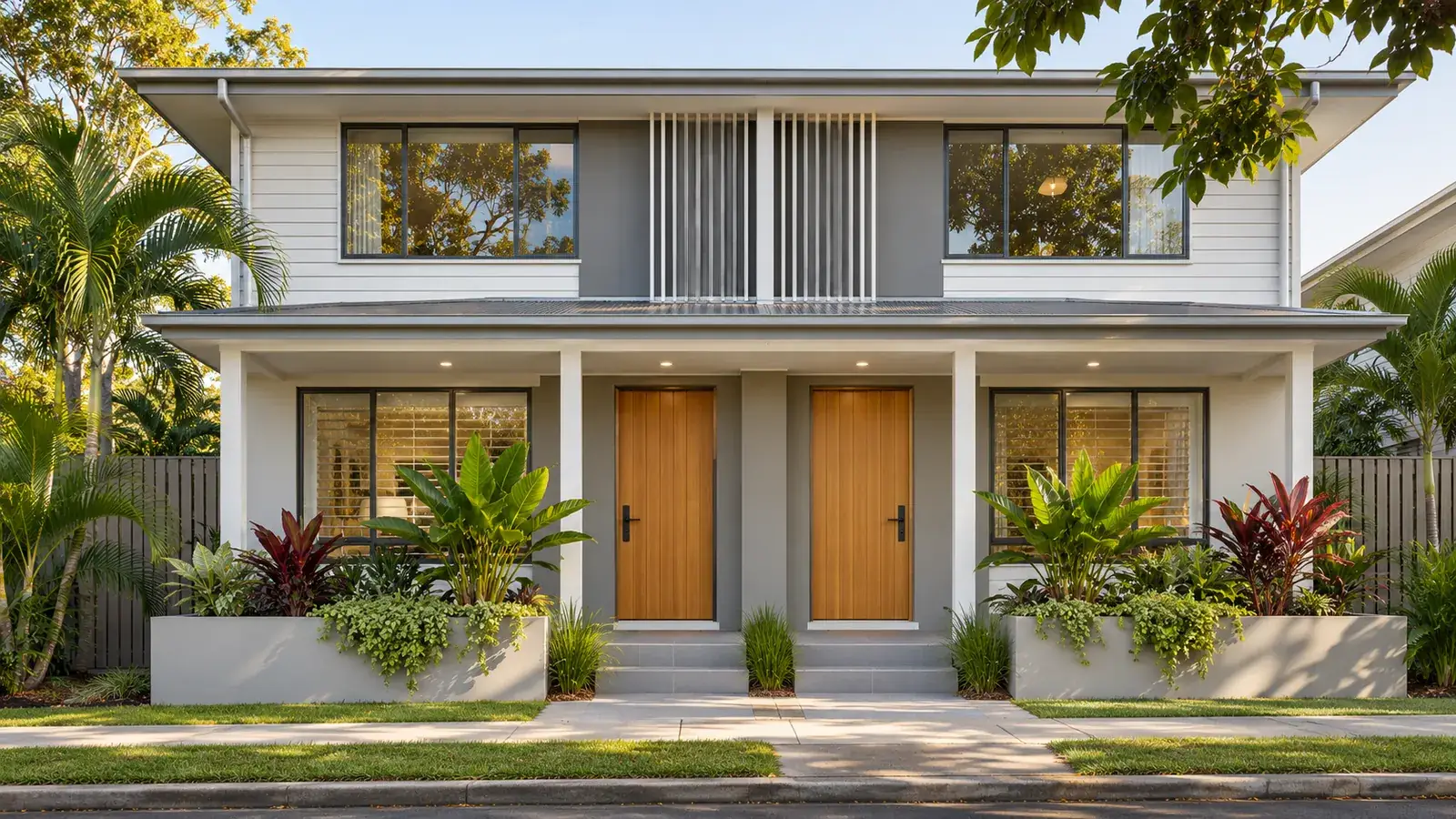
A dual key property is a single dwelling designed as two: typically a larger main home and a smaller studio or one-bedroom unit, sharing a front entry, foyer or roof. Each part has its own lockable door, kitchen and bathroom, so the two can be let on separate leases. They are most common in townhouse and house-and-land projects in south-east Queensland, and in some apartment buildings elsewhere.
Because the two parts share structure and sit on one title, a dual key is one property for lending, insurance, rates and resale, even though it earns two rents.
Dual key vs dual occupancy vs granny flat
| Dual key | Dual occupancy | House + granny flat | |
|---|---|---|---|
| Structure | One building, two parts | Two dwellings on one lot | House plus a separate small dwelling |
| Titles | One, usually permanently | One; can often be split | One; generally can't be split |
| Who buys it later | Mostly investors | Investors and owner-occupiers | Families and investors |
| Lending | Varies a lot by lender | Usually treated like a house | Treated like a house |
| Learn more | This page | Dual occupancy guide | Granny flat guide |
The case for and against dual key
- For: higher gross rent. Two leases on one property usually earn more than a single lease on a similar home.
- For: partial vacancy. If one part is empty, the other still pays.
- For: flexibility. You can live in one part and rent the other, or house a family member.
- Against: narrow resale market. Most owner-occupiers don’t want a home split in two, so buyers are mostly investors.
- Against: more management. Two tenancies, two bonds, more turnover and wear, and higher management fees in dollar terms.
- Against: growth. Dual keys are often sold new in estates with plenty of similar stock, which can hold back capital growth.
Read the advertised yield carefully. A new dual key’s rent estimate is a forecast; check it against what similar dual keys in the same estate are actually leasing for. Our guide to what counts as a good rental yield explains why a high yield on a new estate product can be a warning sign rather than a bargain.
How do lenders and valuers treat dual key?
Lender appetite varies more for dual key than for a standard house. Some lenders accept it like any other home; others treat more than one dwelling on a title as higher-risk security assessed case by case, and require the property to be readily saleable with wide appeal (one lender’s published policy, September 2026). Expect some lenders to cap the loan-to-value ratio, to count only part of the second rent, or to decline.
Valuers need comparable sales of similar dual keys. In an estate where every dual key was sold new by the same developer, there may be few genuine resales, so the bank’s valuation can come in below the contract price. Get finance approval on the specific property, not just a pre-approval, before the contract goes unconditional.
What to check before buying a dual key
- Council approval for two separately rented parts, and the building classification and fire separation that go with it.
- Actual leased rents for both parts in the same estate, not the developer's rent guarantee or appraisal.
- Resales of similar dual keys nearby, and how long they took to sell.
- Separate meters for power and water, so each tenant can be billed directly.
- Body corporate fees and rules if it's in a strata scheme, and whether the scheme limits renting.
- Your lender's policy on this exact property before you sign.
If you’re still deciding on the property type, our guide to every type of investment property compares the options side by side.
What this means for property investors
Dual key can be a sensible cash-flow play, particularly with interest rates higher and negative gearing limited on established property bought after 12 May 2026. But the extra rent comes with weaker resale and harder lending, so it suits investors who prioritise income over growth and plan to hold for the long term. Buy where there is a real resale market, not just a new estate selling the same product. Rising Returns compares dual key options with alternatives for clients as part of our investment property buyers agent service.
Sources (checked 20 November 2026)
Weighing up a dual key?
Book a free discovery call. We'll compare it with a standard house, a dual occupancy and a granny flat in the same area.
Book a free discovery callDual key property: common questions
What is a dual key property?
A dual key property is a single home on one title that is split into two self-contained parts, each with its own kitchen and bathroom and a lockable door, usually behind a shared front entry or within one building. The two parts can be rented separately, so one purchase produces two rents.
Are dual key properties a good investment?
Dual key properties can produce higher gross rent than a standard home of the same price, which helps cash flow. The trade-offs are a narrower resale market, more wear and turnover, two sets of tenancy admin, and lenders who may cap or decline the loan. They suit cash-flow-focused investors more than growth-focused ones.
Can you subdivide a dual key property?
Usually not. A dual key property sits on one title by design, and the two parts typically share structure, services or an entry that can't be legally separated. If you want the option of two titles later, look at a dual occupancy or duplex that the council will allow to be subdivided.
Do banks lend on dual key properties?
Many lenders do, but policies vary more than for a standard house. Some treat more than one dwelling on a title as higher-risk security, assess it case by case, lower the loan-to-value ratio or count only part of the rent. Ask your broker to confirm the specific lender's policy before you sign.
Is a dual key the same as a granny flat?
No. A granny flat is a separate secondary dwelling on the same lot as a house, usually a detached building. A dual key is one building split into two self-contained parts. Both give two rents from one lot, but a granny flat leaves the main house as a normal family home if you sell.
Where are dual key properties common?
Dual key properties are most common in Queensland, particularly south-east Queensland growth corridors, and in some apartment and townhouse projects in other states. Planning schemes treat them differently, so check how the local council classifies the design and whether both parts can be rented separately.
General information only. It doesn’t consider your personal circumstances and isn’t financial, tax, credit or legal advice. Speak to a licensed professional before you act.