Guide
Dual occupancy investment in Australia: rules, costs and returns
Two homes on one block can mean two rents from one parcel of land. Here's what dual occupancy actually is, how the rules differ by state, what it costs, how lenders see it, and how to tell a good one from a dud.
By Mossy Taheri, licensed buyer’s agent · Updated
The short answer
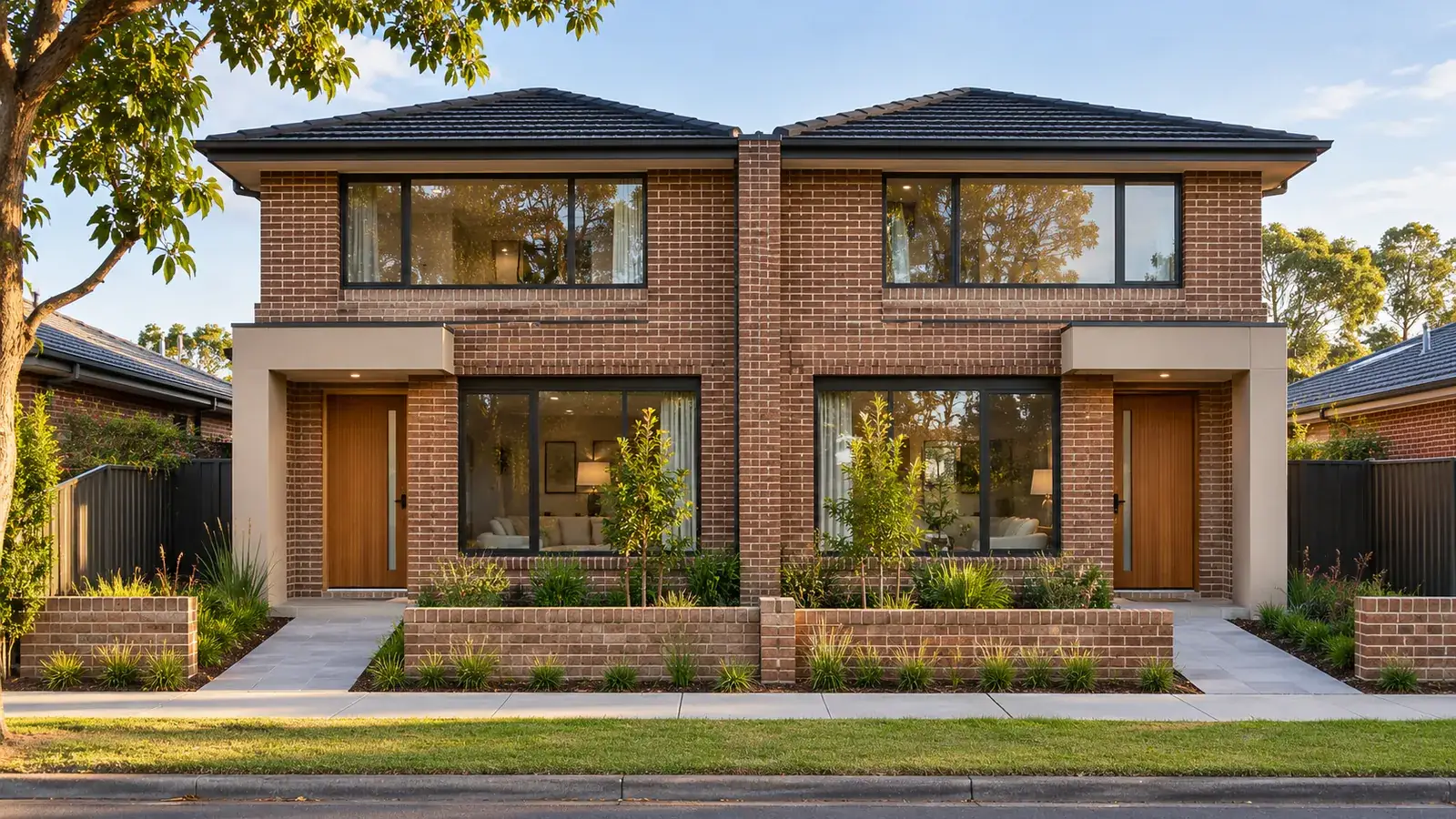
A dual occupancy is two separate homes on one block of land, attached (a duplex) or detached. It can produce two rents from one parcel of land, and in some councils the lot can later be split into two titles. It works when the land, the combined rent and the resale market support it, and fails when the build cost is more than the value it adds. Planning rules decide most of that, and they differ by state and council.
What counts as dual occupancy?
Dual occupancy means two dwellings on one lot, each with its own kitchen, bathroom and entry. Planning law usually splits it into two forms.
| Type | What it is | Separate titles later? |
|---|---|---|
| Attached dual occupancy (duplex) | Two homes sharing a common wall on one lot | Often, if the council allows the subdivision |
| Detached dual occupancy | Two separate houses on one lot, e.g. front and back | Often, subject to minimum lot sizes |
| House and granny flat | A main house plus a smaller secondary dwelling | Generally no (see granny flat investment) |
| Dual key | One building split into two self-contained parts | Usually no (see dual key property) |
The difference matters. A dual occupancy that can be subdivided gives you the option to sell one home and keep the other, or refinance each separately. A house and granny flat or a dual key stays one property for good.
Why investors buy dual occupancy
The appeal is simple: more rent from the same land. The detail is where the value is made or lost.
- Two rents, one block. Land is usually the expensive part. Two homes on it can lift the combined rent well above what one house would earn.
- Vacancy risk is split. If one side is empty, the other still pays.
- Optional subdivision. Where the council allows it, two titles can be created later to sell or refinance one side.
- New build depreciation. A newly built pair gives larger depreciation claims than an older house.
- Wider resale market than other two-rent options. A good duplex appeals to owner-occupiers as well as investors, which a dual key or rooming house usually doesn’t.
What are the dual occupancy rules in each state?
Dual occupancy is approved by local councils under state planning law, so the rules depend on the zone, the lot and any overlays. These are the state settings as of November 2026.
New South Wales
Dual occupancies are permitted with consent in R2 low-density residential zones across NSW, and may be permitted in other zones under the council’s local plan. Within the low and mid-rise housing areas (residential land within 800 metres walk of nominated town centres and stations), the standards are a minimum lot size of 450 square metres and a minimum width of 12 metres, a 0.65:1 floor space ratio and a 9.5 metre height limit. Subdivided lots in R1, R2 and R3 zones can be as small as 225 square metres and 6 metres wide (NSW Planning).
Victoria
A planning permit is always required for two or more dwellings on a lot in the residential zones. Since 31 March 2025, the Townhouse and Low-Rise Code in Clause 55 sets deemed-to-comply standards: if a design meets all of them, the related objectives are met and objectors have no right of appeal to VCAT on those standards (Planning Victoria). That makes a compliant design faster and more predictable to approve.
Queensland, WA, SA, Tasmania and the territories
Dual occupancy is set by each council’s planning scheme. Queensland councils such as Brisbane, Gold Coast and Logan define where it is accepted, and on what lot sizes; WA uses the R-Codes density coding of the lot; SA uses the Planning and Design Code zones. Always check the specific lot with the council or a town planner before paying for “dual occupancy potential”.
Should you build a dual occupancy or buy one finished?
| Build on a block | Buy a finished pair | |
|---|---|---|
| Upfront cost | Land, approval, design and construction | One purchase price |
| Risk | Approval, build cost and builder risk | Overpaying, build quality |
| Timeline | Often 18 months or more to rent | Rent from settlement |
| Upside | Development margin if done well | Little or none; you pay retail |
| Stamp duty | On the land only (usually) | On the full price |
Building can create equity but adds approval, cost and timing risk. Buying finished avoids that but means you pay a price that already includes the developer’s margin. Our development feasibility calculator shows whether a build stacks up before you buy the land.
How to run the numbers on a dual occupancy
Compare the dual occupancy with the simple alternative: a single house on the same street.
- Get a written rental appraisal for each dwelling, not one combined figure.
- Add the extra costs: two lots of insurance and maintenance, possibly two water meters, and any shared-area upkeep.
- Check land tax: some states assess the land once, but values and thresholds still change the bill.
- Test the cash flow at higher interest rates in the cash flow calculator.
- Compare the total with what a single house would rent for, and ask whether the extra rent justifies the extra cost and risk.
For a quick read on what yield to expect, see what is a good rental yield.
How do lenders treat dual occupancy?
Most lenders treat a dual occupancy on one title much like a house. One broker’s published policy summary in May 2026 showed investor lending of up to 95% for duplexes, tightening to around 70% to 80% for small blocks of up to four units (Home Loan Experts). Valuers compare the pair with similar sales nearby, so a dual occupancy in a street with no comparable sales can value below what it cost. Confirm the lender, the valuation and the rent they will count before you sign.
How is dual occupancy taxed?
- Rent from both dwellings is assessable income, and the costs of earning it are generally deductible.
- A new build gives capital works and plant and equipment depreciation; get a depreciation schedule.
- If you live in one side and rent the other, the main residence capital gains tax exemption is usually only partial.
- If you build to sell, the profit can be ordinary income and GST can apply. The ATO’s guidance on small-scale subdivisions explains how purpose decides it.
What are the risks, and what should you check?
- Planning. Zone, overlays (heritage, flood, bushfire), minimum lot size and frontage, and whether subdivision is allowed.
- Build quality. For finished pairs: inspections, warranties, and whether each side meets current building standards.
- Resale market. Are owner-occupiers buying duplexes in the street, or only investors?
- Rent balance. A front dwelling and a rear one rarely rent the same; check both.
- Shared services. Separate meters, driveways and drainage make tenancies and a future subdivision easier.
Our due diligence checklist covers the general checks. For how dual occupancy compares with other property types, see our guide to every type of investment property.
What this means for property investors
Dual occupancy is one of the few ways to lift income without buying more land, and NSW and Victoria have both made approvals more predictable since 2025. The investors who do well buy land in streets where duplexes already sell to owner-occupiers, check the council’s rules for the specific lot, and run the numbers against a plain house. Rising Returns assesses dual occupancy sites and finished pairs for clients across Australia as part of our investment property buyers agent service.
Sources (checked 20 November 2026)
Looking at a dual occupancy?
Book a free discovery call. We check the planning rules, rents, lending and resale before you commit to a site or a finished pair.
Book a free discovery callDual occupancy: common questions
What is a dual occupancy property?
A dual occupancy is two separate dwellings on one lot of land, either attached (a duplex) or detached (two houses, or a house and a second dwelling). Each dwelling has its own kitchen, bathroom and entry. Whether the two can later be put on separate titles depends on the council and state subdivision rules.
Is dual occupancy a good investment?
Dual occupancy can be a good investment when the land value, rents and resale market support it, because two rents come from one parcel of land. It is a poor investment when the build cost exceeds the value it adds, when only investors would buy it, or when one dwelling is much harder to rent than the other.
Can I build a dual occupancy on my block in NSW?
In NSW, dual occupancies are permitted with consent in R2 low-density residential zones state-wide. Within the low and mid-rise housing areas near nominated town centres and stations, the standards are a minimum lot size of 450 square metres and a minimum width of 12 metres. Check your council's planning controls before you buy.
Do I need a planning permit for a dual occupancy in Victoria?
Yes. In Victoria's residential zones a planning permit is always required for two or more dwellings on a lot. Since 31 March 2025, Clause 55 has deemed-to-comply standards: a design that meets them all can't be appealed to VCAT by objectors, which shortens and de-risks approval.
What is the difference between dual occupancy and dual key?
A dual occupancy is two dwellings on one lot, usually with separate entries and often able to be subdivided later. A dual key is one dwelling split into two self-contained parts behind a shared entry or structure, sitting on one title. Dual occupancies tend to resell to a wider market; dual keys suit investors chasing yield.
Can I get a normal home loan for a dual occupancy?
Usually. Most lenders treat a dual occupancy on one title like a house, and some lenders publish investor loan-to-value ratios of up to 95% for duplexes. Lender appetite narrows when there are more than two dwellings on a title, so confirm the policy with your broker before you sign a contract.
How much rent does a dual occupancy earn?
A dual occupancy earns two rents, but each is usually lower than a full house would earn in the same street, because each dwelling is smaller. The gain is in the combined rent compared with the land cost. Get a written rental appraisal for each dwelling and compare the total with a single house before you buy.
General information only. It doesn’t consider your personal circumstances and isn’t financial, tax, credit or legal advice. Speak to a licensed professional before you act.