
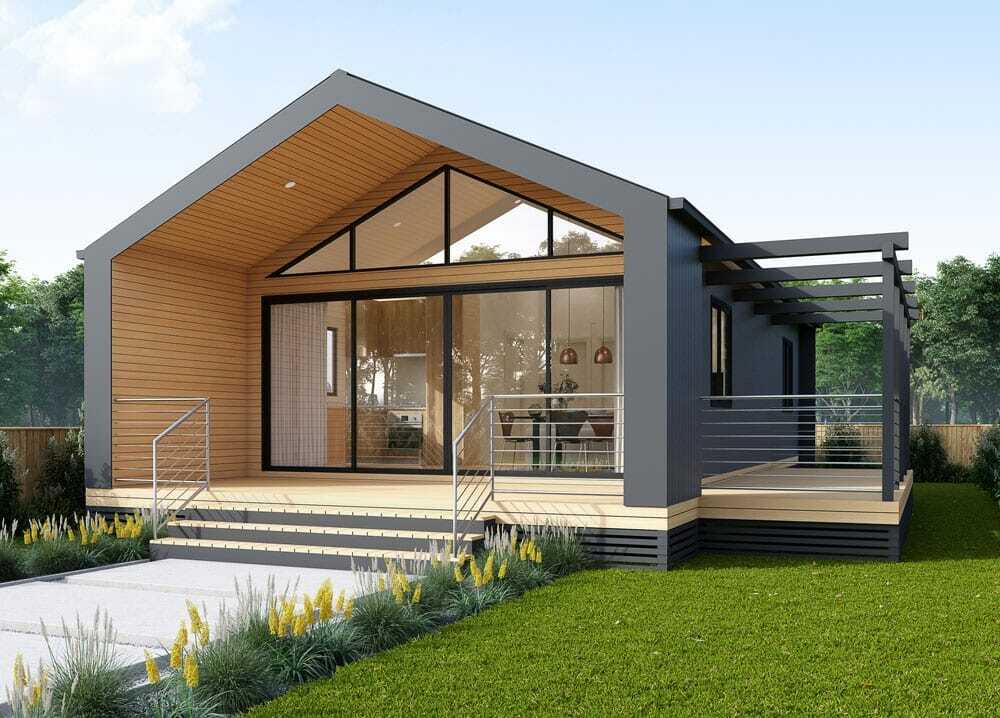
The Reserve Bank lifted the cash rate by 0.25 percentage points to 4.85% on 3 November 2026, according to the RBA. For investors carrying negatively geared property, that has revived an old idea: build a granny flat out the back, collect a second rent, and let the extra income soak up higher repayments.
It sounds like a hedge. Often it isn't. A granny flat investment is usually funded with more debt, and more debt means every rate rise costs you more in dollars. Whether the second rent covers that depends on one number most investors never calculate.
This guide models a house with and without a granny flat across four interest rates, shows where the granny flat stops helping, and gives you a simple test to run before you build.
Key takeaways
- A granny flat adds debt as well as income. Each 1 percentage point rise in rates costs an extra 1% of the build cost every year, while the granny flat's rent stays the same.
- Every granny flat has a break-even interest rate. It equals the granny flat's net extra income divided by the extra debt. Above that rate, the granny flat makes your cash flow worse, not better.
- In our illustrative model the break-even rate is about 7.8%. At 6.5% the granny flat improves cash flow by $3,150 a year; at 8.5% it costs $1,850 a year.
- Build cost matters more than rent. A $70,000 difference in build cost can move the break-even rate by more than 2 percentage points.
- The building depreciates; the land grows. A granny flat rarely adds its full cost to the property's value, and it cannot be subdivided onto its own title in NSW or Victoria.
- Our view: build only when the granny flat's net yield on cost sits comfortably above your borrowing rate, with room for at least a 2-point rise.
In this guide
- Does a granny flat protect you from rising interest rates?
- The model: a house with and without a granny flat
- What happens to cash flow as rates rise
- How to calculate your granny flat break-even rate
- The costs that don't show up in the rent
- What this means for property investors
- Frequently asked questions
- The bottom line
We test every property against 250+ data points
Find out what that looks like for your budget.
Does a granny flat protect you from rising interest rates?
Only if it earns more than it costs to fund. A granny flat improves cash flow when its net rent is higher than the interest on the money borrowed to build it. As rates rise, that interest grows while the rent does not, so the granny flat's advantage shrinks and can reverse.
The logic investors usually follow is: "If rates go up, I'll have a second rent to help." That is true in isolation. But the granny flat is not free. If it cost $250,000 and you borrowed the lot, you now carry $250,000 more debt than an investor who bought the same house and left the backyard alone.
At 6.5%, that extra debt costs $16,250 a year. At 8.5%, it costs $21,250. The granny flat's tenant does not pay you an extra $5,000 because the RBA moved. So the very scenario the granny flat was meant to protect against is the one that erodes its benefit.
The model: a house with and without a granny flat
We compared two investors who put the same cash into the deal. Investor A buys a house. Investor B buys the same house and borrows an extra $250,000 to build a granny flat. Figures are illustrative, pre-tax and interest-only, to isolate the effect of rates.
| Assumption | A: House only | B: House + granny flat |
|---|---|---|
| Purchase price | $900,000 | $900,000 |
| Granny flat build (all-in, incl. approvals and connections) | – | $250,000 |
| Loan | $720,000 | $970,000 |
| Main house rent | $700/wk ($36,400 a year) | $670/wk ($34,840 a year) |
| Granny flat rent | – | $480/wk ($24,960 a year) |
| Holding costs (rates, insurance, management, maintenance) | $10,500 | $14,500 |
| Net income before interest | $25,900 | $45,300 |
Two assumptions are worth flagging. First, we've cut the main house rent by $30 a week. Tenants pay less for a house that shares its backyard, driveway and privacy with another household. Second, the granny flat adds $4,000 a year in management fees, insurance, maintenance and shared utilities. Ignoring either flatters the granny flat.
So the granny flat lifts net income by $19,400 a year, in exchange for $250,000 of extra debt.
What happens to cash flow as rates rise
The granny flat helps at lower rates and hurts at higher ones. In our model it improves annual cash flow by $3,150 at a 6.5% interest rate, is roughly neutral at 7.5%, and costs the investor $4,350 a year at 9.5%.
| Interest rate | A: House only (annual cash flow) | B: House + granny flat (annual cash flow) | Granny flat advantage |
|---|---|---|---|
| 6.5% | –$20,900 | –$17,750 | +$3,150 |
| 7.5% | –$28,100 | –$27,450 | +$650 |
| 8.5% | –$35,300 | –$37,150 | –$1,850 |
| 9.5% | –$42,500 | –$46,850 | –$4,350 |
Read the last column. Every 1 percentage point rise in rates moves the granny flat's advantage down by $2,500 a year, which is simply 1% of the $250,000 extra debt. That loss is linear and predictable. What changes from deal to deal is where the starting point sits.
Note also that both investors go backwards as rates rise. The granny flat does not make Investor B immune; it makes B more sensitive. B's cash flow falls by $9,700 for each 1-point rise, against $7,200 for A.
Lenders build this sensitivity in. Since October 2021, APRA has expected banks to assess borrowers at least 3 percentage points above the loan rate. On a larger loan, that buffer bites harder, which can limit your next purchase.
How to calculate your granny flat break-even rate
Divide the granny flat's net extra income by the extra debt used to build it. The result is the interest rate at which the granny flat stops improving your cash flow. If your borrowing rate is below it, the granny flat helps; above it, the granny flat costs you money every year.
Break-even rate = (granny flat rent – lost main-house rent – extra holding costs) ÷ extra debt
In our model: ($24,960 – $1,560 – $4,000) ÷ $250,000 = 7.76%.
That figure is also the granny flat's net yield on cost: the annual net income the granny flat produces as a percentage of what it cost to build. The table shows how sensitive it is to build cost.
| Scenario | Build cost | Granny flat rent | Net extra income | Break-even rate |
|---|---|---|---|---|
| Lean build, existing services | $180,000 | $450/wk | $17,840 | 9.9% |
| Our model | $250,000 | $480/wk | $19,400 | 7.8% |
| Premium build or difficult site | $320,000 | $500/wk | $20,440 | 6.4% |
The rent barely moves across these scenarios. The build cost does the damage. A granny flat that costs $320,000 needs rates to stay below about 6.4% just to break even on cash flow, before you consider whether it adds that much to the property's value.
The costs that don't show up in the rent
Cash flow is only half the case. A granny flat also changes the property's growth profile, its resale market and your borrowing capacity, and most of those changes work against the investor.
- The building depreciates; the land appreciates. Long-term growth comes mainly from land. A granny flat adds building value, which wears out. A valuer may not add the full build cost to the property's value. We explain why land share matters in what makes a property investment-grade.
- You can't sell it separately. In NSW, a lot with a secondary dwelling cannot be subdivided, and complying development requires a lot of at least 450 m². In Victoria, a small second dwelling cannot be placed on its own lot. If you want two titles, you're looking at a dual occupancy, which is a different project with different costs.
- Size limits cap the rent. NSW secondary dwellings in residential zones are generally limited to 60 square metres. Victoria raised its small second dwelling limit from 60 to 80 square metres on 15 October 2026 under Amendment VC306, according to the Department of Transport and Planning.
- A narrower buyer pool. Owner-occupiers with young families may see a granny flat as lost backyard. Investors will pay for it only if the numbers work at the rates of the day.
- Lenders may not count all of the rent. Policies on secondary-dwelling income vary between lenders. Check with your broker before assuming the second rent will lift your borrowing capacity.
- Tax changes the picture, not the logic. Interest and depreciation deductions soften the after-tax cost, but the break-even rate is a cash flow test. The rules have also changed for property bought after 12 May 2026, so get advice on your own position and read our explainer on negative gearing reform.
What this means for property investors
A granny flat is a leveraged development project, not a rate hedge. It can work well, but only when the numbers clear a margin that survives higher rates. Here is how we'd approach it.
- Work out your break-even rate before you get quotes approved. Use real figures: an all-in build cost (approvals, connections, landscaping, fees), a realistic granny flat rent from recent leases, and a lower main-house rent. Our property cash flow calculator will run both versions.
- Stress-test at your rate plus 2 percentage points. With the cash rate at 4.85% and the RBA expecting inflation above 3% over the coming year, according to its 3 November statement, assuming rates fall soon is not a plan.
- Our view: aim for a net yield on cost at least 2 points above your current borrowing rate. That leaves the granny flat cash-flow positive relative to the house alone even if rates rise meaningfully.
- Compare it with other uses of the same $250,000. That capital could pay down debt, fund a deposit on a second property in a stronger land-value market, or sit in an offset account earning your mortgage rate tax-free. Our guide to how the cash rate affects property growth covers the trade-offs.
- Don't let cash flow outrank growth. A higher yield today can come at the cost of long-term capital growth, a pattern we cover in why "self-funding" deals can underperform and how cash flow property really works.
The investors who do well with granny flats tend to buy the right block first: a large, flat lot with rear access and services nearby, in an area with deep rental demand for one- and two-bedroom homes. The site makes the numbers; the granny flat just completes them.
Frequently asked questions
Is a granny flat a good investment in Australia?
A granny flat can be a good investment when its net rent, after lost main-house rent and extra costs, is well above the interest on the money borrowed to build it. If the build cost is high relative to rent, a granny flat can reduce cash flow and add little to the property's long-term value, which comes mainly from land.
Does a granny flat help if interest rates rise?
A granny flat helps with rising interest rates only while its net rent exceeds the interest on its share of the loan. Because building a granny flat usually adds debt, each 1 percentage point rate rise costs an extra 1% of the build cost each year, while the granny flat's rent stays the same. Past the break-even rate, it worsens cash flow.
How do I calculate a granny flat's break-even interest rate?
Calculate a granny flat's break-even interest rate by subtracting lost main-house rent and extra holding costs from the granny flat's annual rent, then dividing by the extra debt used to build it. For example, $19,400 of net extra income on $250,000 of extra debt gives a break-even rate of about 7.8%.
What rental yield should a granny flat achieve?
A granny flat should achieve a net yield on its build cost comfortably above the investor's borrowing rate. Our view is that a margin of at least 2 percentage points is prudent, so the granny flat still improves cash flow if rates rise. Net yield should account for lower main-house rent and the granny flat's own running costs.
Does a granny flat add value to a property?
A granny flat adds some value to a property, but a valuer may not add its full build cost. Long-term capital growth comes mainly from land, and the granny flat is a depreciating building. Its appeal at resale also depends on the buyer: investors value the rent, while some owner-occupiers prefer the backyard.
Can you subdivide a granny flat onto its own title?
A granny flat generally cannot be subdivided onto its own title in NSW or Victoria. NSW Planning states that a lot with a secondary dwelling cannot be subdivided, and Victoria's planning rules prevent a small second dwelling from being placed on its own lot. Investors wanting two titles should look at dual occupancy instead.
How big can a granny flat be in NSW and Victoria?
A granny flat in a NSW residential zone is generally limited to 60 square metres under the Housing SEPP. In Victoria, a small second dwelling can be up to 80 square metres from 15 October 2026, up from 60 square metres. Local councils, overlays and lot sizes can add further conditions in both states.
Is a granny flat better than a dual occupancy for investors?
A granny flat is cheaper and faster than a dual occupancy but stays on one title, so it cannot be sold separately. A dual occupancy costs more and takes longer, but can create two saleable dwellings where zoning allows. The better choice depends on the site, the budget and whether the investor wants income or a development profit.
The bottom line
A granny flat can lift cash flow, but it does so with borrowed money, which makes it more exposed to rising rates, not less. Before you build, calculate the break-even rate, stress-test it at 2 points higher, and compare it with the other things $250,000 could do. If you want a second set of eyes on the numbers, or help finding a block where a granny flat genuinely stacks up, our investment property team models every scenario before we recommend a purchase. You can also see how we compare in our guide to the best buyer's agents in Australia.
This article is general information only and does not constitute financial, legal or tax advice. It does not take into account your personal circumstances. Figures are indicative and current at the date of publication; verify independently and seek professional advice before making investment decisions.

Written by the team at
Rising Returns
A licensed, data-driven buyers agency led by founder Mossy Taheri, buying investment property across Australia.
General information only. It does not take into account your objectives, financial situation or needs. Consider seeking independent financial, legal and tax advice before acting.